
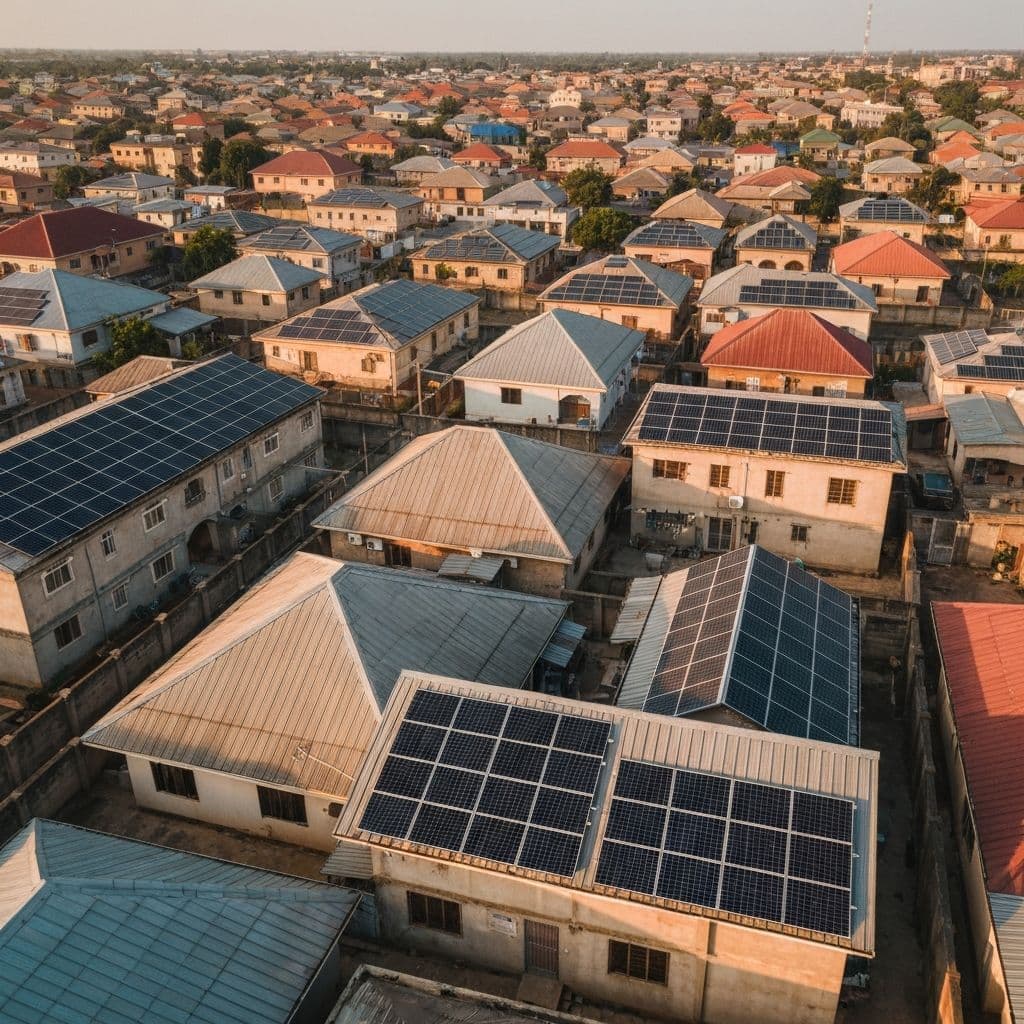
How Many Solar Panels Do You Need for Your Nigerian Home?
"How many solar panels do I need?" is the second most common question our engineers receive, right after "How much does it cost?" The answer depends on several factors — your daily energy consumption, how many hours of sun your location receives, and the capacity of your batteries and inverter.
This guide walks you through the exact calculation method our engineers use, simplified so you can estimate your own requirements.
Step 1: Calculate Your Daily Energy Consumption
You need to know how many kilowatt-hours (kWh) of energy your home uses per day. Here is how to estimate it:
Daily kWh = Sum of (Appliance Wattage × Hours Used Per Day) ÷ 1,000
Example: Typical 3-Bedroom Home in Kano
Appliance | Watts | Hours/Day | Daily kWh
LED Lights (12 × 9W) | 108W | 5 | 0.54
Ceiling Fans (4 × 70W) | 280W | 14 | 3.92
43-inch TV | 80W | 6 | 0.48
Decoder | 20W | 6 | 0.12
Refrigerator (200L) | 150W | 24 (compressor ~50%) | 1.80
Laptops (2 × 65W) | 130W | 8 | 1.04
Phone chargers | 50W | 3 | 0.15
1HP Split AC | 900W | 8 | 7.20
Water pump | 750W | 0.5 | 0.38
**Total** | **15.63 kWh/day**
Step 2: Know Your Peak Sun Hours
Peak sun hours (PSH) is not the number of daylight hours — it is the number of hours per day that the sun produces 1,000W per square metre of energy. This is the standard unit for solar calculations.
Peak Sun Hours by Location in Nigeria:
City | Average PSH (Annual) | Dry Season PSH | Wet Season PSH
Kano | 6.8 hours | 7.5 hours | 5.8 hours
Kaduna | 6.5 hours | 7.2 hours | 5.5 hours
Katsina | 7.0 hours | 7.8 hours | 6.0 hours
Sokoto | 7.3 hours | 8.0 hours | 6.2 hours
Abuja | 5.8 hours | 6.8 hours | 5.2 hours
Lagos | 5.2 hours | 6.0 hours | 4.5 hours
Port Harcourt | 4.5 hours | 5.5 hours | 3.8 hours
Northern Nigeria has significantly more peak sun hours than the South — this is one reason solar installations in Kano are so productive.
Step 3: Calculate the Solar Array Size Required
Formula:
Solar Array Size (Watts) = Daily Energy Consumption (Wh) ÷ Peak Sun Hours × System Loss Factor
The system loss factor accounts for inverter efficiency, cable losses, and temperature derating. Use 0.75–0.80 for Nigerian conditions.
For our 3-bedroom Kano example:
Solar Array = 15,630Wh ÷ 6.8 PSH ÷ 0.78 = 2,952W
Round up to the next panel count. Using 450W panels:
2,952 ÷ 450 = 6.56 → Round up to 7 panels
However, in practice, most installations use even numbers of panels for cleaner wiring. So 8 × 450W panels (3,600W total) would be the practical recommendation.
Step 4: Check Your Inverter Limits
Your inverter has a maximum solar input (MPPT input power). Make sure your panel array does not exceed this.
For a Deye 5kVA inverter (SUN-5K-SG03LP1-EU):
- Maximum PV input: 6,500W
- 8 × 450W = 3,600W — well within limits
For larger arrays, you may need a larger inverter or multiple inverters.
Step 5: Factor in Battery Recharge Requirements
Your solar panels must also recharge your batteries each day, not just power your loads in real time. If you use 15.63kWh per day and generate 3.6kW × 6.8 hours = 24.48kWh per day, you have 8.85kWh surplus — which means your 10.24kWh battery bank (two Deye 5.12kWh batteries) will be fully recharged every day.
If the numbers are tight, increase panel count by 1–2 panels.
Quick Reference: Panels Needed by Home Type
Home Type | Load Profile | Panels Needed (450W) | Array Size
1 bedroom, no AC | Basic | 2–3 panels | 900–1,350W
2 bedroom, no AC | Standard | 4 panels | 1,800W
3 bedroom, 1HP AC | Comfortable | 6–8 panels | 2,700–3,600W
4 bedroom, 2 × 1.5HP AC | Premium | 10–14 panels | 4,500–6,300W
Small office/shop | Business | 6–10 panels | 2,700–4,500W
Common Mistakes in Solar Panel Sizing
Over-relying on "solar panel calculator" websites: Most online calculators use global averages, not Nigerian-specific data. A calculator designed for the UK will give you wrong answers for Kano.
Not accounting for seasonal variation: Design for the wet season (lower PSH), not just the dry season. Your system should still work adequately in June and July.
Ignoring panel temperature derating: In Kano's heat, panels can operate at 60–70°C surface temperature, reducing output by 10–20%. Our calculation above already accounts for this via the 0.78 system loss factor.
Buying cheap panels to save money: A 400W panel from an unbranded manufacturer may actually produce only 360–370W in real conditions. Always buy from Tier 1 manufacturers with certified performance warranties.
Get Your Free Panel Count Calculation
Contact Dayspark and share your appliance list. Our engineers will calculate the exact number and type of panels needed for your home — considering your specific location, roof orientation, potential shading, and budget.
